

In the fast-paced world of Canadian athletics and rehabilitation sciences, the “field” is where the action happens. Whether it is a high-performance training center in Vancouver or a gait analysis clinic in Toronto, Kinesiology is fundamentally a study of human potential in motion. However, for a Kinesiologist in training, the most critical “game-winning” play often doesn’t happen on the turf—it happens in the laboratory.
The transition from observing a physiological response to documenting it with scientific rigor is the hallmark of a successful academic career. In Canada, where Kinesiology programs are globally recognized for their research output, the ability to produce precise, data-driven lab reports is not just a requirement; it is a professional necessity for future health practitioners.
Technical Rigor in UofT and UBC Kinesiology Programs
The academic standards at the University of Toronto (UofT) and the University of British Columbia (UBC) are among the highest in the world. Kinesiology is no longer just “physical education.” It is a multidisciplinary field encompassing biomechanics, neurophysiology, psychomotor behavior, and ergonomics. When a student conducts a $VO_2$ max test or a surface Electromyography (sEMG) analysis, the data collected is raw and volatile. The lab report is the instrument that transforms this raw data into actionable health insights.
For many student-athletes balancing a rigorous training schedule with a heavy course load, the pressure to maintain academic excellence can be immense. Seeking professional assignment help is a common strategy to manage these complex technical requirements effectively. MyAssignmentHelp provides localized support to students across Canada, ensuring that their academic documentation reflects the same precision found in their physical training. By utilizing expert guidance, students can ensure their reports adhere to the specific formatting and citation standards (such as APA 7th edition with Canadian nuances) required by their respective faculties.
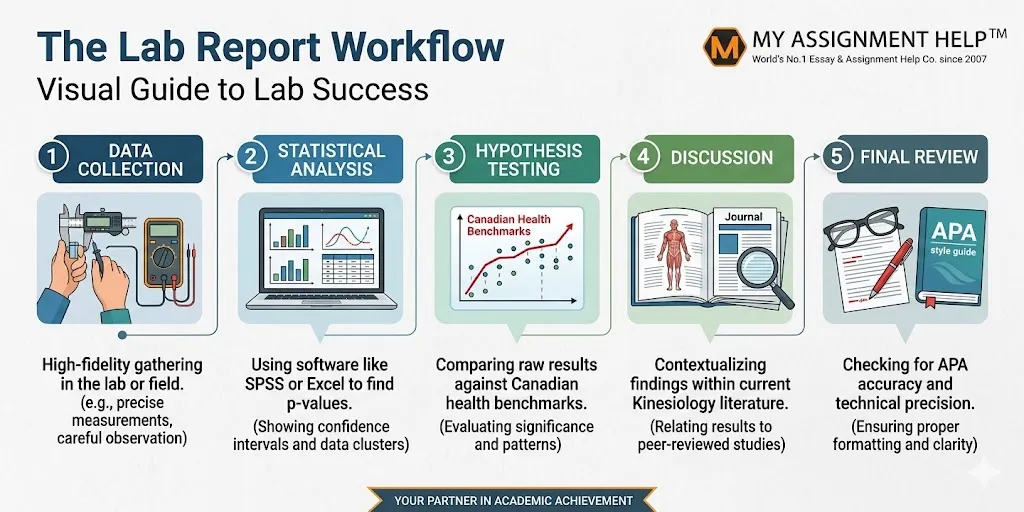
Furthermore, specialized tasks like biomechanical charting or metabolic calculations require a level of detail that goes beyond general writing. Accessing a dedicated lab report writing service can help students master the “Discussion” and “Results” sections, where most marks are typically lost due to imprecise data interpretation or weak statistical analysis.
Why Precision is Non-Negotiable in Kinesiology
Precision in lab reporting serves three primary functions in the Canadian academic and professional landscape:
1. The Safety and Ethics Protocol
In a clinical setting, an error in calculating a patient’s heart rate variability or muscle fatigue threshold isn’t just a “bad grade”—it’s a safety risk. Canadian Kinesiology programs emphasize the Code of Ethics set by the Canadian Kinesiology Alliance (CKA). Accurate reporting in the lab trains students to be responsible practitioners who can be trusted with public health.
2. Evidence-Based Practice (EBP) in Ontario and Beyond
Canada’s healthcare system relies heavily on Evidence-Based Practice. Whether you are aiming to become a Registered Kinesiologist (R.Kin) in Ontario or a Physiotherapist in Alberta, your ability to interpret lab data determines the efficacy of the treatment plans you create. A report that lacks precision fails to provide the “evidence” required for EBP.
3. Peer Review and Reproducibility
Scientific progress in Kinesiology depends on the ability of other researchers to reproduce your results. If a lab report’s “Methodology” section is vague or the “Data Analysis” is inconsistent, the study loses all scientific credibility.
Key Takeaways for Canadian Students
- Data Integrity: Always double-check unit conversions (e.g., converting $kg$ to Newtons in biomechanics).
- The “Discussion” Section: This is where you shine. Don’t just restate the data; explain why it matters in a real-world Canadian health context.
- Professional Alignment: Treat every lab report as a professional document that could be presented to the Canadian Society for Exercise Physiology (CSEP).
- Time Management: Use academic tools and support services early to avoid the “crunch” that leads to sloppy reporting.
Frequently Asked Questions (FAQ)
Q: What is the most common mistake in Kinesiology lab reports?
A: Most students fail to connect their lab results to existing physiological theories. They provide the “what” but forget the “so what.”
Q: Do Canadian universities have specific formatting for lab reports?
A: Yes. While APA is standard, many Canadian institutions (like Waterloo or McGill) have specific “Lab Manuals” that override general APA rules for table formatting.
Q: Should I include “Raw Data” in the main body of the report?
A: Usually, no. Raw data belongs in the Appendix. The “Results” section should only contain processed data (means and standard deviations) presented in clear tables.
About the Author
Liam Richardson is a Senior Content Strategist at MyAssignmentHelp with over a decade of experience in Canadian academic consulting. Specializing in STEM and Health Sciences, Liam helps students navigate the complexities of technical writing and research documentation. He holds an advanced degree in Exercise Science and is a frequent contributor to discussions on the evolution of Kinesiology education in Ontario.
